Customer proof
A claim is easier to assess when the evidence is clear.

A company can have years of successful delivery and still struggle to show a prospective customer why its claims deserve attention. The evidence may sit in account notes, presentation files, support records or the memories of experienced people. Marketing then falls back on broad descriptions because the useful detail has not been collected and approved.
Customer proof work brings that detail into a form people can use. It identifies the claim, gathers the supporting evidence, records permission and explains the result in context. The output may be a case study, but it may also be a short process example, an implementation explanation or a clear account of a specialist decision.
Crediria treats proof as part of buyer confidence. The question is not how many testimonials a company can display. It is whether the available evidence helps the intended buyer understand the service, its relevance and its limits. A small collection of appropriate examples can be more useful than a large collection of unrelated praise.
Begin with the question the buyer needs answered
A buyer evaluating a service may worry about delivery, specialist knowledge, support continuity or the effort required from their own team. Those concerns need different evidence. A general statement that a customer was pleased does not necessarily answer any of them in enough detail.
For an illustrative software implementation provider, a prospect may ask how the project team handles data preparation. A useful proof item could describe responsibilities, checks and the agreed handover. An award for company growth might be credible in another context but would not answer that implementation question.
The first step is therefore to collect recurring buyer questions from sales and delivery colleagues. Group them by decision rather than by marketing format. The resulting list tells the company what evidence to seek before it decides which assets to create.
Distinguish claims, evidence and interpretation
A claim states what the business wants the reader to believe. Evidence supports that statement. Interpretation explains what the evidence means in the relevant situation. Keeping these separate helps prevent an example from becoming a larger promise than the source justifies.
A completed transition record may support a claim that the company has experience managing a particular type of migration. It does not automatically support a claim that every migration will avoid disruption. The interpretation should explain the conditions, responsibilities and lessons from the example.
The proof review should ask whether the evidence actually matches the wording. If the available source only shows that a process was followed, the copy should not claim a financial improvement without additional data. Clear limits strengthen the usefulness of the example because the buyer can understand what it establishes.
Find evidence inside ordinary work
Useful evidence does not always begin as a marketing asset. Delivery plans, approved customer feedback, training records and project reviews can contain material that explains capability. The company needs a way to identify that material without publishing internal documents indiscriminately.
A short interview with an account manager can reveal a recurring question and the example that helped answer it. A conversation with a project lead can identify a difficult decision and the information used to resolve it. Those conversations should then lead back to records that verify the account.
Memory is a starting point, not the final source. Dates, figures and customer statements should be checked against the relevant record. If the account cannot be verified, it may still inform an illustrative scenario, but it should not appear as a factual customer success story.
Create one source record for each proof item
A proof record should identify the customer or anonymised context, the service, the question answered, the source documents, the approved claim and the permission status. It also needs an owner who can answer questions and maintain the material.
For numerical results, record the baseline, measurement period, calculation and any important dependencies. A percentage without those details can be difficult to interpret. If the source measures one team or one process, the claim should retain that scope rather than imply a company-wide result.
The record should link to the assets that use it. That allows the team to update a case study, article, sales slide and proposal example together when the source changes. A single source does not prevent adaptation; it keeps the factual foundation consistent.
Agree permission before creating public material
Customer evidence can involve names, logos, quotes, commercial details and identifiable situations. The company should agree what can be used and in which formats. Permission to mention a customer is not automatically permission to publish a confidential result or use a person's photograph.
The approval request should show the intended wording and context. A customer can then assess whether the statement is accurate and appropriate. Where a quote is edited for length, the approved final version should be retained with the record.
Anonymisation also needs care. A description of sector, location, project timing and unusual circumstances may identify the organisation even without a name. The owner should review the combined detail and remove information that creates an unintended disclosure.
Build a case study around the decision
A useful case study explains the starting situation, the problem, the decisions, the work and the supported result. It also identifies what the customer contributed and what remained outside the supplier's control. That gives the buyer enough context to judge relevance.
The story should avoid making the supplier the sole cause of every positive outcome. A project may depend on customer preparation, another adviser or broader business changes. A precise account can acknowledge those contributions while explaining the supplier's role clearly.
The conclusion should help the reader understand where the example applies. It might identify a similar starting problem, a condition required for the approach or a question to ask before beginning. That is more useful than ending every story with a general invitation to achieve the same result.
Use process proof where outcome proof is limited
Some services do not produce an immediate measurable result, or the customer cannot release the figures. The company can still explain the process, the checks and the decisions. This should be labelled as evidence of approach rather than presented as an outcome claim.
For an illustrative consultancy, a sample workshop structure may show how information is gathered and priorities are agreed. A redacted deliverable can show the type of output. Neither proves that every client will improve sales, but both can help a buyer understand what the engagement involves.
Process proof should be specific enough to examine. A five-word list of stages may provide an overview, but the explanation needs to describe what happens and what the customer receives. The aim is to reduce uncertainty about the work, not to disclose every internal method.
Turn one approved result into several assets
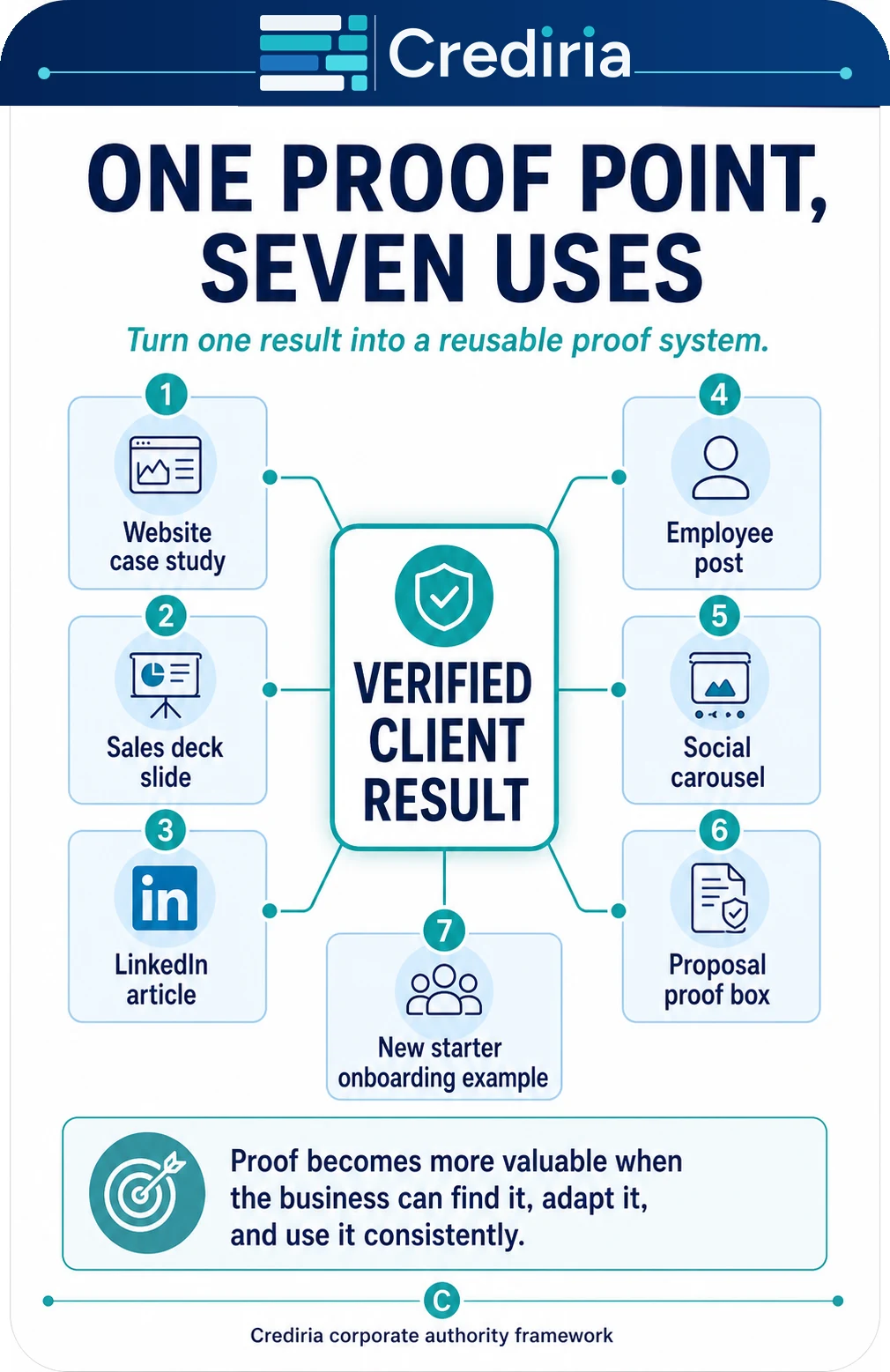
The book's One Proof Point, Seven Uses illustration identifies several practical formats: website case study, sales slide, LinkedIn article, employee post, social carousel, proposal proof box and onboarding example. Each can use the same verified foundation while answering a different question.
A website case study provides context. A sales slide highlights the relevant decision. An employee post adds a role-specific observation. A proposal proof box connects the example to the prospective customer's concern. An onboarding example helps new colleagues understand the company's work.
Reuse should preserve the conditions and permissions. A short asset may need a link to the fuller explanation. If the format cannot carry the qualifications required to make the claim accurate, the team should change the wording or use a different proof item.
Make proof easy for sales to find
A sales colleague needs to locate evidence by buyer question, sector, service or delivery concern. A folder containing dozens of files with vague names creates friction. A simple index can provide the relevant claim, audience, permission status and asset link.
The index should distinguish public-ready material from internal context. A salesperson should not have to guess whether a customer quote can be forwarded. Clear status labels reduce that uncertainty and make it easier to use approved evidence in a timely response.
Searchability also helps identify gaps. If the team has several examples about expertise but none about implementation, that finding can inform the next evidence-gathering task. The aim is coverage of important decisions, not a large asset count.
Use proof in outreach without overloading the message
A first email rarely needs a full case study. It needs enough relevant context for the recipient to decide whether to investigate. One supported observation and a useful article link may be sufficient. The fuller evidence belongs on a destination that explains it properly.
Follow-up messages can address different concerns across the sequence. One may explain the problem, another the approach and another the evidence required for a decision. Fourteen messages should not repeat the same meeting request fourteen times with slightly different wording.
When a prospect replies, the conversation should determine which proof is appropriate next. Continuing the standard sequence regardless of the reply can make the company appear inattentive. The approved evidence collection supports a more relevant human response.
Use research to explain context
Published research can help explain why a subject deserves attention. It should be distinguished from evidence about the company's own delivery. A study about buyer confidence may support the need for useful information; it cannot verify a supplier's customer result.
The company should retain the source and publication details in the reference list. The main explanation can remain readable while allowing a reader to check the study. Claims should reflect the population and question studied rather than imply a universal finding.
Older research can remain relevant to an argument when its scope is clear. It should not be presented as a measurement of today's campaign performance. The company should also check whether the original finding actually supports the specific point being made.
Keep employee contributions accurate
Employees can help explain proof by adding their perspective on the work. A delivery manager may discuss preparation, while an account manager explains communication. Those contributions should remain within what each person knows and is authorised to share.
The editor should not imply that an individual delivered the entire project if their role was narrower. Nor should a centrally written post invent a personal experience to make the result sound more relatable. A useful contribution can describe a professional observation without claiming a fictional memory.
Each contributor should approve the final wording. The proof owner should confirm factual consistency and permission. This keeps individual voice and source accuracy connected rather than treating them as competing requirements.
Review proof after publication
An approved asset needs maintenance. Services change, customer permissions may change and links can break. A review date and named owner make that maintenance visible. The review should check accuracy, availability and continued relevance to the active offer.
When a claim changes, the team should update all linked uses. That may include a sales deck, website article, proposal template and scheduled post. Keeping an asset map saves time and reduces the chance that an old version remains in circulation.
The team should also record feedback. If prospects repeatedly ask for a missing detail, the case study may need a clearer explanation. If sales colleagues cannot use the asset because it lacks relevant context, the format may need adjustment.
Measure usefulness in the sales process
Proof measures can begin with availability and use. How many important buyer questions have an approved answer? Can sales find the material? Is it used in proposals or follow-up? These checks establish whether the proof process supports the team.
Commercial observations can include prospects referencing an example, asking a more specific question or forwarding material to another stakeholder. Record those observations as such. A later sale may involve many influences, so the company should avoid attributing the full outcome to one proof asset without evidence.
The strongest review combines asset quality with conversation feedback. A beautifully designed case study may still answer the wrong question. A short, precise explanation may help a buyer more. The company should improve the material based on relevance rather than visual polish alone.
A thirty-day proof project
During week one, collect recurring buyer questions and identify potential evidence. During week two, verify the sources and agree customer permission. During week three, create a full explanation and a small set of derivative assets. During week four, test whether sales and customer-facing colleagues can find and use them.
The project should begin with a manageable set of proof items. Two well-supported examples can establish a repeatable process. Attempting to turn every past engagement into a case study at once may create a queue of approvals and inconsistent drafts.
The end-of-month review should record completed assets, missing permissions and unresolved evidence gaps. That gives leadership a realistic view of what is ready for campaigns and what still requires work.
Saturday action: find one supported claim
Select one claim from the company's service page. Find the record that supports it. Write down the source, the relevant period, the limits and the permission needed for public use. If the evidence does not match the claim, correct the wording or assign a task to gather the missing support.
Then identify three uses that answer different buyer questions. A case study, a sales follow-up paragraph and an employee observation may be enough for the first test. Link each use to the same source record so future corrections can reach all three.
Crediria's proof asset review helps companies identify, organise and prepare this material. It can connect with sales trust work and employee visibility, giving the evidence a practical role across the customer journey.
Check the evidence from another stakeholder's position
The first contact may understand a case study while a finance, operations or procurement colleague needs a different explanation. Before finalising the proof pack, ask which questions those people are likely to raise. A finance reviewer may need the calculation basis. An operations reviewer may need responsibilities and dependencies. A procurement reviewer may need clarity about scope and contractual commitments.
This does not mean producing a separate case study for every role. The full source can contain the context, while shorter extracts address the relevant question and link back to the explanation. The company should avoid removing necessary qualifications merely to make the extract shorter. If the detail is important to interpreting the result, it belongs in the buyer's view.
A useful final check asks a colleague outside the original project to read the asset and describe what it proves. Compare that answer with the approved claim. If the reader reaches a stronger conclusion than the evidence supports, the wording needs adjustment. If the reader cannot identify the relevance, the explanation needs more context. Both checks help the company prepare material that can travel between stakeholders without becoming misleading.
Book illustration
The accompanying infographic presents a reuse method from the book's corporate authority material. It does not claim that seven formats produce seven leads or a guaranteed sales result. Each published example needs an appropriate source, permission and explanation of its relevance.