Buyer confidence
A prospect can check the company before replying.

A founder can spend weeks improving an outbound campaign and still overlook the pages a prospect opens after receiving the first email. The message earns attention. The website, company page and leadership profiles then need to explain whether the business deserves a conversation. If those places tell different stories, the prospect has to do extra work before deciding what to believe.
That creates a practical distinction between reaching a buyer and reassuring a buyer. Contact data, sending capacity and a persuasive subject line help with reach. Clear positioning, relevant expertise and accessible evidence help with reassurance. A company needs both. Increasing outreach before checking its public presence can simply expose the same unanswered questions to more people.
Crediria treats this as a commercial review. The aim is to identify what a prospective customer needs to understand, what evidence is available, and where the company makes that evidence difficult to find. The first improvement might be a clearer service page, a better leadership introduction or one useful customer example. It does not automatically require a complete rebrand.
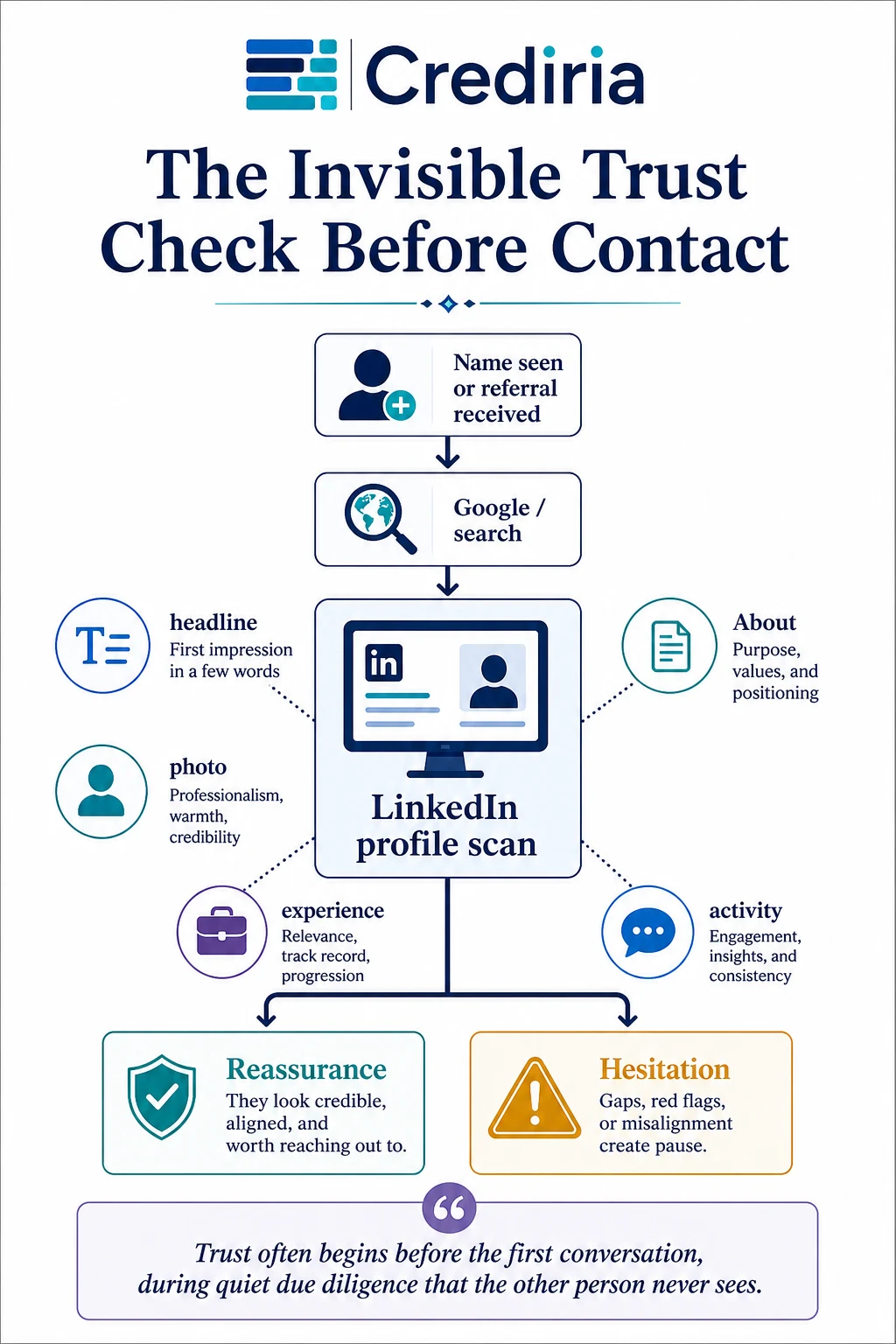
The decision before the sales conversation
Consider an illustrative situation. A managing director receives a message from an unfamiliar IT services provider. The email describes a relevant problem with service handovers. Before responding, the director searches the business, checks the founder and opens the service page. The company describes itself as innovative, customer focused and committed to excellence. None of those phrases explains how it manages the handover problem.
The director may still respond. But the company has made the response depend on curiosity rather than reassurance. A specific explanation of its onboarding process, responsibility split and experience with similar organisations would provide more useful information. This example is a hypothetical buying situation, not a reported Crediria client result.
The pre-contact decision is often modest: whether to open another page, ask a colleague, save an article or reply. Public credibility supports those smaller decisions. The company does not need to close the sale through its website. It needs to give the right person a reasonable basis for taking the next step.
What the research supports
In IDC's study of 760 B2B buyers, 75% reported using social media to assist purchasing decisions. The finding supports a specific point: professional research and social networks can form part of buying activity. It does not establish that a social post causes a purchase or that every company's customers behave in the same way. The source and publication details appear below.
The distinction matters when a company turns research into marketing. A statistic can make a subject easier to understand, but it should retain its original meaning. A study about assistance with purchasing should not become a claim that three quarters of buyers purchase through LinkedIn. That stronger statement would describe a different behaviour.
For a founder, the useful question is narrower than whether social media works in general. Does the business provide enough relevant information in the places its own prospects check? Customer interviews, sales notes and enquiry conversations can help answer that question alongside published research.
Start with a defined buying situation
A credibility review becomes more useful when it begins with one buying situation. An owner looking for a payroll provider has different concerns from an operations director replacing a telecoms contract. The pages may look similar, but the reassurance required is different. One buyer needs confidence in payroll accuracy and confidentiality. The other needs clarity about transition, availability and support.
The company should record the role, trigger, problem and immediate next decision. For example: an operations director whose current service contract is approaching renewal needs to decide whether a new supplier merits a discovery call. That description gives the team a concrete context for reviewing public material.
Starting with one situation does not restrict the company permanently. It creates a manageable first test. Once the team understands the gaps for that audience, it can repeat the review for other sectors, service lines or buyer roles without assuming that the same evidence answers every question.
Review the path a prospect can actually follow
The review should follow the links available to an unfamiliar visitor. Begin with the email signature or company name. Search the organisation. Open the website, the relevant service page, the company LinkedIn page and the profiles of people likely to join the first meeting. Record what each place says about the same service.
This is different from reviewing the website navigation in isolation. A campaign may take visitors directly to an article. A colleague may forward a founder's post without the company introduction. A profile may appear in search before the homepage. Each entry point should make sense without requiring the visitor to reconstruct the whole story.
Useful observations include a service mentioned in an email but missing from the website, a profile linked to an old employer, a customer example with no explanation of the work, or a contact route that does not describe what happens next. These are specific defects that can receive an owner and a deadline.
Replace vague promises with useful detail
Words such as quality, expertise and reliability may describe real strengths, but they leave the buyer to decide what those strengths mean. A stronger explanation identifies the work, the conditions and the intended outcome. It may also describe how the company handles difficulties. That makes the claim easier to examine.
For an illustrative telecoms provider, a useful service explanation could cover the discovery stage, migration responsibilities, support arrangements and dependencies on the customer's existing infrastructure. It should only include commitments the business can deliver. Specific language is helpful because it narrows ambiguity, not because a longer promise sounds more impressive.
A practical editing exercise is to underline every claim that could appear on a competitor's website without changing a word. Then ask what evidence or operational detail makes the claim distinctive. If no answer is available, the team can either gather support or remove the claim until it can explain it properly.
Match proof to the concern
A large customer logo does not answer every buying concern. It may show that the company has worked with a recognisable organisation, but it does not explain what was delivered or whether the engagement resembles the prospect's situation. Proof becomes more useful when the buyer can see the relationship between the example and the question.
For a buyer worried about implementation, a short account of the transition process may help more than an award. For a buyer worried about specialist knowledge, an article explaining a difficult decision may help more than a general testimonial. For a buyer worried about delivery ownership, named responsibilities and escalation arrangements may matter most.
The business should build a small proof register rather than collect impressive material indiscriminately. Each item needs a source, permission status, relevant audience, supported claim and owner. A customer result should also retain the measurement period and important limitations. That reduces the risk of a useful example becoming an overstated promise.
Make leadership profiles consistent with the company
A founder's profile can support a company introduction by explaining experience, present responsibilities and relevant judgement. It can also create confusion if the profile focuses on an unrelated venture while the company promotes a different service. Buyers should be able to understand the relationship without guessing.
Consistency does not mean copying the company description into every personal profile. A founder, technical director and account manager have different responsibilities. Their profiles should explain those differences while keeping the company name, current role and service context accurate. The shared message concerns the business; the individual detail concerns each person's contribution.
A useful review covers the headline, About section, current experience, visible links and recent activity. It asks whether the profile helps a relevant buyer understand the person they may meet. The company should involve the individual in changes and avoid publishing achievements, testimonials or customer information without approval.
Explain the next step clearly
A contact button is more useful when the visitor knows what the conversation is for. A diagnostic discussion, service enquiry and workshop booking are different requests. A founder who has just read an article may want to discuss one concern before considering a larger project.
The page should explain the purpose of the call, the information that would help and the likely next decision. For Crediria, the initial discussion concerns the company, its intended buyers and the credibility gaps it wants to investigate. Any paid review or workshop scope follows from that discussion.
Clear expectations can reduce unsuitable enquiries as well as support suitable ones. They allow a prospect to decide whether the offer matches the situation. A company should avoid claiming a free report, instant assessment or booked meeting unless the corresponding process is available and works.
Use articles to answer questions before outreach
An article should provide a useful answer even if the reader never contacts the company. For founder campaigns, that might mean explaining how to review leadership profiles, organise customer evidence or identify a weak service introduction. The article then gives an email or LinkedIn post somewhere relevant to send an interested reader.
The connection should be specific. An email about founder dependence should lead to an article about distributing visible expertise, not a general homepage. A post about implementation concerns should lead to a relevant explanation or proof example. The destination should continue the subject the reader has chosen to investigate.
This also creates a more meaningful measurement plan. Campaign links can identify which subject brought a visitor to the site. The team can then review article engagement, enquiries and conversations together. It should avoid treating a page view as proof that the visitor trusts the company or intends to buy.
A five-part review meeting
A small company can begin with a focused meeting involving leadership, marketing and a customer-facing colleague. Before the meeting, each person follows the same prospect path independently. They record observations rather than rewrite pages. Independent notes help reveal differences between what insiders expect to see and what the public material actually says.
The meeting covers five questions: who the page is for, what problem it explains, what evidence supports the claims, which person or team delivers the work, and what the visitor can do next. Each question should produce a finding tied to a page or asset rather than a general judgement about the brand.
After the review, select a small number of changes. Assign an owner, completion date and acceptance check. For example, a service-page change is complete when a colleague unfamiliar with that service can accurately describe the target buyer, the work and the next step. Publishing new copy alone is not the whole check.
Choose improvements by commercial relevance
Some gaps matter more than others. A minor visual inconsistency on an old article may be less urgent than an unclear service page used in an active campaign. A missing implementation explanation may matter more than adding another leadership photograph. Priorities should follow the buying situation and the material prospects actually encounter.
A practical order is to resolve contradictions first, clarify the active offer second, add relevant proof third and improve supporting content fourth. That sequence is a recommendation, not a universal rule. If a broken contact route prevents enquiries, it should take priority immediately.
The team should also distinguish between an editing task and a missing business decision. If nobody agrees who the service is for, the copywriter cannot solve the underlying uncertainty through better wording. The decision belongs with the service owner and leadership before public copy is finalised.
What to measure over the first month
The baseline should include the campaign audience, the pages used, the questions prospects ask and the number of suitable conversations. Record delivered emails separately from replies, positive replies separately from all replies, and booked calls separately from attended calls. Those distinctions make results easier to assess.
Website measures can include visits to the relevant article, movement to the service page and enquiry completion. Sales notes can capture whether prospects mention the content or ask questions already addressed on the site. These observations help identify useful patterns but do not establish causation on their own.
The first month is a learning period. The company may discover that one audience needs more operational detail, another wants customer examples and a third is outside the offer's scope. Those findings should influence the next round of content and targeting rather than simply increasing the volume of the original campaign.
Keep the review proportionate
A company does not need to publish every internal document to appear credible. It needs to select information that helps the buyer understand the service while protecting customer confidentiality and internal working methods. A clear explanation of the process can be useful without exposing private tools or commercial information.
Similarly, an article should not imply that visible credibility removes the need for due diligence. Buyers still need to assess suitability, contracts, commercial terms and delivery risk. Public material supports that investigation; it does not replace it. A responsible company makes its claims easier to check rather than asking prospects to suspend judgement.
The strongest first step is therefore a manageable one: choose one audience, follow its likely research path, identify three unanswered questions and correct the material that should answer them. That gives the business a practical starting point before committing to a larger programme.
Saturday action: the pre-contact check
Set aside thirty minutes with one colleague who does not write the company's marketing. Give that person the opening email intended for the founder campaign. Ask them to follow the links and searches they would use to investigate the business. They should write down what they understand and what they still need to know.
Compare those notes with the intended message. Select one contradiction, one unsupported claim and one missing explanation. The following week's work should correct those three items, with a named owner for each. Repeat the exercise after publishing to check whether the changes improved understanding.
Crediria's diagnostic workshop provides a structured way to run this review across leadership, marketing and sales. The resulting priorities can inform a 90-day implementation programme. The decision begins with the gaps the company needs to resolve, rather than a predetermined list of content tasks.
Give the review a clear owner
A credibility review can lose momentum when everyone agrees with the findings but nobody owns the corrections. Leadership should nominate one coordinator to maintain the action list and bring unresolved decisions back to the relevant service owner. That person does not need to write every page. They need to make the work visible and ensure that completed changes receive a practical check.
The coordinator should record what changed, the reason for the change and the evidence used. This creates a useful baseline for the next review. It also prevents the business from revisiting the same wording discussion without remembering the decision that was made. The first month should leave the company with both better public material and a clearer way to maintain it.
References and reading
IDC, Social Buying Meets Social Selling: How Trusted Networks Improve the Purchase Experience, April 2014, sponsored by LinkedIn. Sample: 760 B2B buyers across the United States, Canada, France and the United Kingdom. The research is supporting evidence from its original study period, not a measurement of Crediria campaign performance.