Employee visibility
Useful contributions start with real expertise.

A company can publish the same announcement through twenty employees and still say very little about the people who deliver its work. The repeated message may increase distribution, but it does not automatically demonstrate expertise. If every account uses the same opening, example and conclusion, the reader receives another company statement rather than an individual perspective.
Employee visibility becomes more useful when people explain what they know within a shared company direction. A delivery manager can discuss implementation. An account manager can clarify customer questions. A specialist can examine a difficult technical choice. The company supplies accurate context, evidence and support; each person contributes a perspective they can stand behind.
That requires preparation. Asking employees to post more often without giving them time, guidance or relevant material can leave the programme dependent on a few confident volunteers. Crediria approaches employee advocacy as a working process involving participation, permissions, preparation, review and measurement. A posting schedule is one part of that process.
Define the commercial purpose first
A programme should begin with the audience and the questions the company wants to help answer. Is the aim to explain specialist capability, make leadership more visible, support recruitment or improve buyer understanding before a sales conversation? Those purposes can overlap, but a first campaign needs a clear priority.
For an illustrative B2B services company, the first priority might be helping prospects understand implementation responsibility. A delivery manager's account of project preparation could support that aim. A general celebration of the team's energy would offer less relevant information, even if it attracted more reactions.
The company should record the purpose in a short brief: intended audience, important question, supported message, available evidence and next step. Contributors can then decide how their own experience relates to it. That gives the programme direction without requiring identical posts.
Understand why people hesitate
Silence should not immediately be interpreted as a lack of commitment. An employee may worry about customer confidentiality, spelling, public criticism or accidentally speaking outside their authority. Another may not know which parts of routine work would interest an external reader. Some people simply do not want to use a personal account for company promotion.
A useful discovery conversation asks what support would make participation easier and which subjects the person feels comfortable discussing. It should also make clear that participation arrangements can differ. A person may contribute knowledge to a company article without publishing through their own profile.
The programme needs a practical answer to these concerns. That might include editing help, approved examples, short interviews or a clear escalation contact. The answer should not be a general instruction to be authentic. People need to know what they can do and who will help them do it.
Keep personal accounts personal
An employee's profile contains their career history and professional relationships. Company support should respect that ownership. The business can propose profile corrections and content ideas, but the individual should approve changes and publications made through their account.
Participation terms should describe account access, approval and what happens if the employee changes role or leaves. A company should not quietly treat a personal profile as another corporate publishing channel. A clear agreement helps both parties understand the boundaries before the programme grows.
People should also identify their employment relationship when endorsing their employer's services. The reader needs that context to assess the contribution. Disclosure does not make an observation less useful; it makes the relationship easier to understand.
Create shared direction with individual subjects
The company can select a weekly subject such as preparing for a supplier transition. Different contributors then address the parts they understand. The founder explains the commercial decision, the delivery lead discusses planning and the account manager describes recurring questions about continuity.
These posts can share a factual foundation without sharing every sentence. The contributor's role determines the example, level of detail and useful action. That produces a series with coherent company direction and distinct professional perspectives.
A short subject map helps. It records each person's responsibilities, topics they can explain, relevant evidence and areas requiring review. This prevents the team from assigning a technical claim to someone who cannot validate it, or asking everyone to comment on the same leadership subject.
Capture knowledge before writing posts
People often find it easier to explain a decision in conversation than to write a public post from a blank page. A fifteen-minute interview can capture a recent question, a common misconception and a practical check. The editor then turns those notes into a draft for the person to review.
The interview should separate publishable information from background context. Customer names, contract details and sensitive figures may help an editor understand the situation without belonging in the final post. The contributor should identify those boundaries during preparation, not only after a draft has circulated.
A useful capture template asks what the decision was, why it was difficult, what the person considered, what they can safely explain and what a reader could do next. The aim is to preserve judgement rather than create a dramatic story around an ordinary event.
Give contributors approved evidence
A contributor should not have to search old presentations to find out whether a claim can be used. The company needs a small collection of approved facts, examples and assets. Each item should identify its owner, source, permission status and relevant service.
Evidence can include a published research finding, a customer-approved result, a process explanation or a demonstration of specialist reasoning. These forms support different claims. A research statistic may explain the market context, while a customer result supports a statement about the company's work.
The approved collection should also record limitations. If a result relates to one customer over a particular period, that scope travels with the example. The editor should not turn it into a general promise by removing the conditions that made the original statement accurate.
Replace a long policy with usable decisions
A formal policy may be necessary, but contributors also need day-to-day guidance. They should know which material is ready to use, which needs permission and which cannot be shared. Simple examples can make those distinctions easier to apply.
An approved public service explanation may need only a factual check. A named customer account needs customer permission. An unresolved incident should go to the responsible manager rather than become a post. A personal opinion about an industry issue may need a clear distinction from company policy.
The guide should name the escalation contact and expected review time. If every question waits indefinitely, the programme will stall. If nobody checks sensitive material, the programme creates avoidable risk. A proportionate review process supports both participation and accuracy.
Keep the approval process short
A practical first programme can use three roles: contributor, editor and factual reviewer. One person may perform more than one role, but the responsibilities should remain clear. The contributor owns their voice and approval. The editor improves structure. The factual reviewer checks claims and permissions.
The team can distinguish routine material from sensitive material. An explanation based on an approved article may pass through a short check. A new customer result, commercial promise or regulated subject may require a fuller review. Applying the longest process to every post can discourage participation without improving accuracy.
Feedback should explain the reason for a change. Removing a figure because its source is missing helps the contributor understand the requirement. Rewriting every sentence into corporate language teaches the opposite lesson: that individual perspective is unwelcome despite the programme's stated purpose.
Build posts around a useful question
A good starting structure is a question the contributor can answer, a short explanation, a relevant example and one action. For a delivery lead, the question might concern what a customer should clarify before agreeing a transition date. The post can explain dependencies without exposing a specific customer's situation.
An illustrative example should be labelled as such. A genuine experience should retain the details that can be stated accurately and safely. Editors should not add a fictional client conversation or an invented result simply to make the post more engaging.
The action should fit the subject. It might ask readers to check an ownership table, review a profile link or identify a missing proof item. A useful action gives the post a practical purpose even when the reader has no immediate reason to buy.
Make a sustainable weekly rhythm
A company programme can publish several times each week without expecting every employee to match that frequency. The company page supplies the shared subject. Individuals contribute where they have relevant knowledge and capacity. A small pilot can begin with a founder and two willing colleagues.
A Friday article provides a fuller explanation of the subject. The Saturday action post turns the explanation into a manageable task. The following week's preparation can draw on questions raised by readers, sales conversations and the contributors themselves.
The schedule should include preparation and review time. Publishing commitments that ignore those tasks tend to transfer the workload to one person. A programme becomes more repeatable when interviews, drafting, checking and approval are planned alongside publication.
Support people who prefer another contribution route
Not every useful expert will enjoy posting. A technical colleague may prefer reviewing an article, recording an explanation or contributing answers for the company page. The programme should make room for those routes rather than equating public activity with professional value.
Attribution needs agreement. A company can acknowledge a contributor's expertise where they approve it, or publish the explanation in the company voice where that is more appropriate. The content should not imply that someone made a public endorsement they did not approve.
This approach broadens the knowledge available to the business without forcing a uniform participation model. It also reduces the temptation to fill personal accounts with posts written centrally and published without meaningful individual involvement.
Use one result in several distinct ways
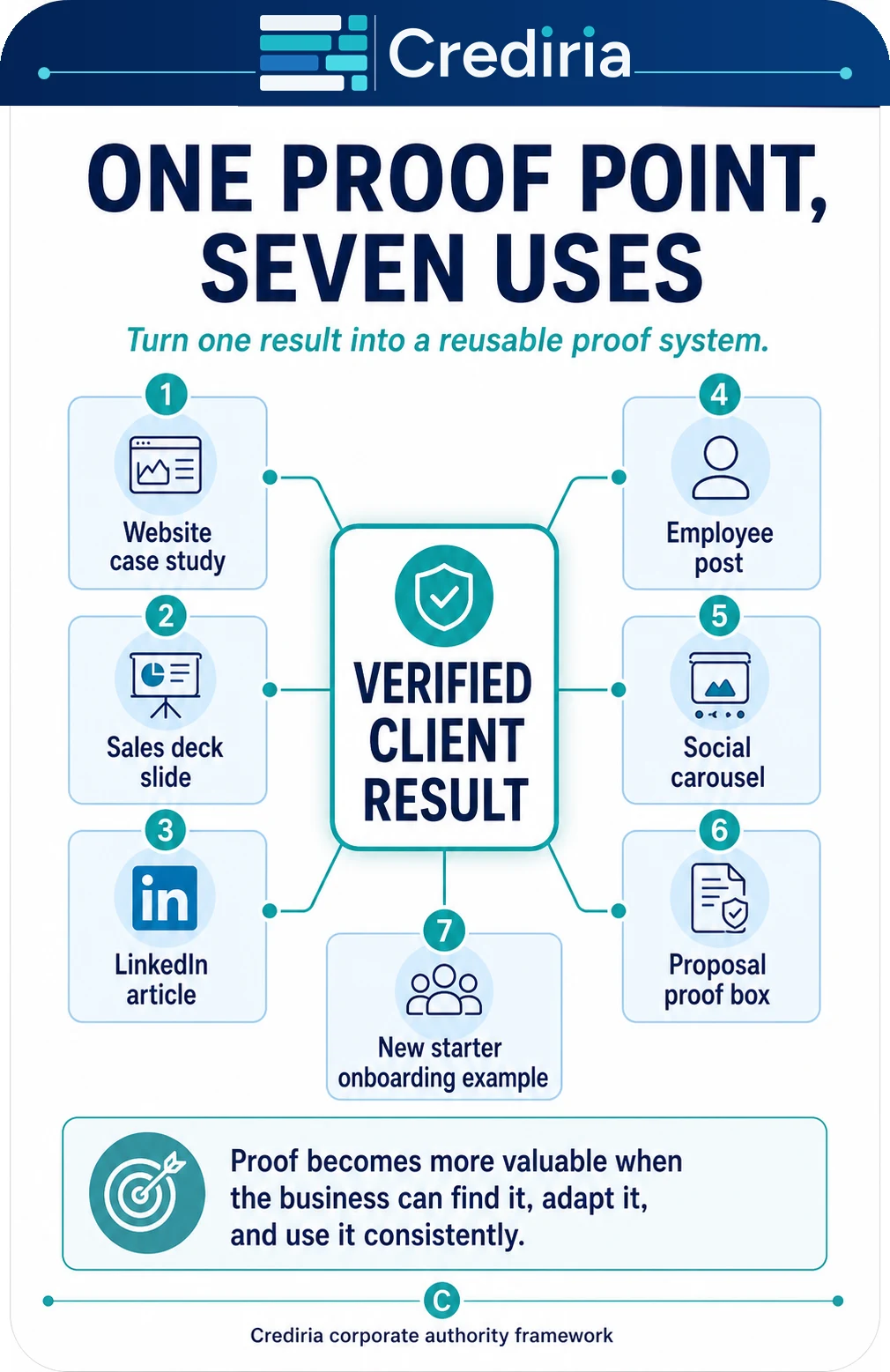
A verified customer result can support a case study, sales slide, article, employee observation and proposal proof box. Each use should answer a different question while retaining the same factual foundation. Reuse saves preparation time when it preserves the source and scope.
The employee post should add a perspective relevant to the person's role. A project manager may explain the preparation that supported the result. A customer success colleague may explain the follow-up process. Neither needs to copy the case study introduction verbatim.
The company should retain one approved source record and link the derivative assets to it. If a customer changes permission or the wording needs correction, the team can identify where the claim appears. That is easier than searching several accounts after a problem arises.
Measure participation and commercial relevance separately
Participation measures show whether the process works for people. Examples include contributors involved, drafts approved, review time and subjects covered. Commercial measures show whether the content supports the intended audience: relevant enquiries, useful conversations and references to the material during sales discussions.
Reach and engagement can help compare subjects, but they do not establish commercial value alone. A widely shared post may reach people outside the target market. A quieter explanation may help a specific buyer understand a service. The company needs enough context to assess both.
Reported outcomes should distinguish observations from attribution. If a prospect mentions an article during a meeting, record that fact. Do not assume the article caused the meeting unless there is evidence for that stronger claim. This makes the programme's reporting more credible.
Recognise warning signs early
A programme needs adjustment if people repeatedly decline drafts because they do not sound like them, if approval takes longer than the publishing cycle, or if posts rely on claims that nobody can verify. Those signals concern the process, not merely the contributors' enthusiasm.
Other warning signs include several employees publishing the same statement at once, profiles that do not reflect current roles and a schedule dominated by company announcements. The team should ask whether the material explains useful expertise or simply redistributes promotion.
The correction may be to reduce volume, interview contributors more carefully or narrow the subject. A smaller programme with clear ownership can establish better habits before expanding. Publishing more of the same material is unlikely to resolve a preparation problem.
A six-week pilot
Week one establishes the audience, purpose and willing contributors. Week two checks profiles and gathers approved material. Week three uses short interviews to prepare the first individual posts. Week four publishes and records questions. Week five adjusts the subjects and approval process. Week six reviews the results and decides whether to continue or expand.
The pilot should produce a usable guide, a small evidence collection, a subject map and a realistic preparation rhythm. It should also identify what the team cannot yet support, such as customer stories awaiting permission or claims without a source.
The decision to expand should consider the contributors' experience as well as campaign results. A programme that depends on unpaid evening work or repeated last-minute rewriting may not be sustainable even if the first posts perform well.
Saturday action: three voices, one subject
Select one question customers regularly ask. Ask three colleagues how they would answer it from their own roles. Record the differences. Identify the shared facts and the perspective each person adds. That material can become a company article and distinct individual contributions.
Before drafting, check which details need permission and which can be stated publicly. Give each colleague the final wording to approve. The test is whether the posts are accurate, useful and recognisable as the contributors' own professional perspectives.
Crediria's employee visibility and advocacy work helps companies establish this process. It connects participation with approved proof assets and a 90-day implementation plan, so the programme has a clear purpose and practical ownership.
Prepare for questions after publication
Publication creates another task: responding to readers. Contributors should know when they can answer directly, when to check a fact and when to refer the question to a colleague. A technical query may deserve a careful response rather than a quick promotional reply. A commercial enquiry may belong with the sales team. A complaint may require an established customer support route.
The programme should allow time for those responses and record useful questions for future content. That creates a connection between publication and learning. If several readers ask the same question, the next company article can address it more fully. If a question exposes a gap in the service explanation, the responsible owner should review the relevant page rather than leave the answer only in a comment.
The contributor should not be expected to remain available at all hours. A realistic response arrangement protects their time and gives the company a repeatable process. It also makes clear that the objective is useful professional participation, with support, rather than a requirement to maintain constant activity on a personal account.
Book illustration
The accompanying One Proof Point, Seven Uses illustration comes from the book's infographic collection. It describes a practical reuse method rather than a measured promise about reach, leads or revenue. All customer evidence still requires its own source and permission.