Leadership visibility
Shared company facts. Individual professional voices.

A founder's LinkedIn profile can explain a business more clearly than its company page, or make the business harder to understand. The difference often lies in a few practical details: the current role, the audience served, the problem addressed and the evidence behind the introduction. A profile does not need to read like a company brochure. It does need to help a relevant person understand why a conversation could be useful.
That becomes especially important when the founder runs more than one business or has worked across several disciplines. A broad career can support credibility, but an unstructured introduction may leave prospects unsure which activity relates to the company contacting them. The answer is not to erase experience. It is to organise the information around a clear present role.
Crediria's leadership visibility review considers the relationship between personal experience and company positioning. It looks at whether the profile provides a useful introduction, whether the claims can be supported and whether the public activity reflects the work the person actually does. The purpose is commercial clarity without turning every employee into the same voice.
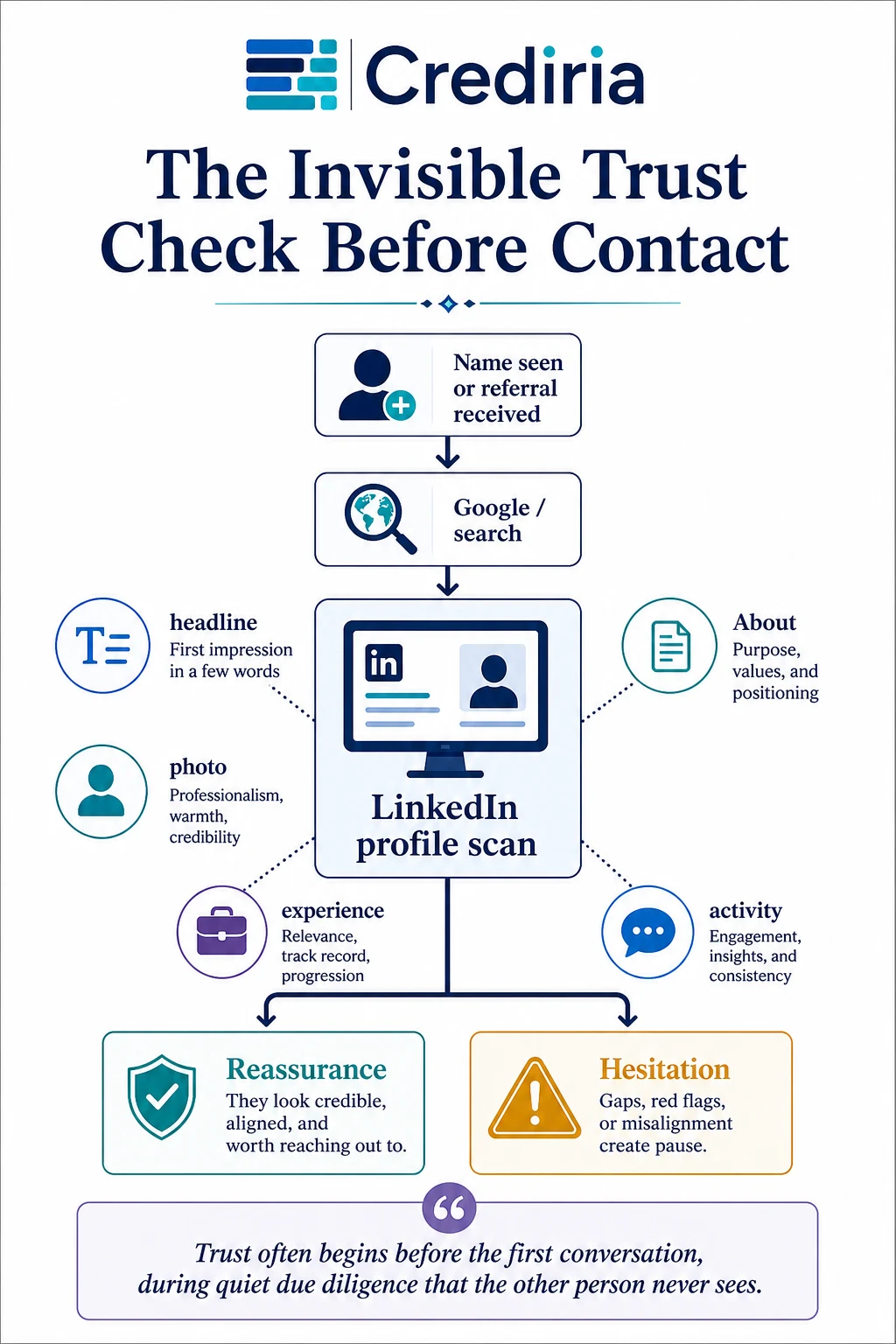
A profile is part of a buying investigation
A prospective customer may open a profile after receiving an email, seeing a comment or hearing a recommendation. The visitor brings a question: who is this person, what do they understand and how do they relate to the service under consideration? The profile should help answer those questions before asking for attention.
The visitor may not read every section. A headline, current role and a few visible examples can shape an initial impression. That does not justify chasing a perfect first impression through inflated wording. It suggests that the most important facts should be easy to identify and consistent across the profile.
For an illustrative founder of a specialist engineering consultancy, a useful introduction might explain the kind of engineering decisions the firm supports and the founder's role in that work. General descriptions such as visionary leader or passionate entrepreneur provide less information about the decision the buyer is trying to make.
Separate personal history from the current offer
A career history can contain several relevant strands. The profile should make the current organisation and role clear, then use previous experience to explain judgement, capability and perspective. An old project should not look like a service currently available unless it still is.
Where several brands coexist, each current experience entry needs an accurate description and link. The About section can briefly explain how the roles relate. It should avoid merging unrelated offers into one long list that asks visitors to decide which company provides which service.
A useful check is to ask a colleague unfamiliar with the founder's work to describe the current business after reading the profile. If the answer focuses on a previous venture or a different service, the information order needs attention. That is a clarity problem, not a criticism of the founder's experience.
Write a headline that establishes relevance
The headline has limited space, so it should prioritise role and relevance. A title identifies responsibility. A short service or audience description adds context. Qualifications or specialist terms belong there only when they help the intended visitor understand the person's contribution.
For example, an illustrative headline could identify a founder as leading a telecoms consultancy that helps multi-site businesses plan service transitions. The exact wording must reflect the real work. It should not add claims about guaranteed savings, market leadership or exceptional results unless the company can support them.
A headline does not have to describe every capability. Its job is to give the reader a reliable starting point. Additional detail belongs in the About and experience sections, where there is room to explain scope, examples and important limitations.
Use the About section to explain the work
A strong About section can follow a simple sequence: present responsibility, the problems addressed, the approach to the work, relevant evidence and a sensible next step. The individual should approve the language and recognise it as an accurate account of their role.
The explanation should use ordinary terms wherever possible. A buyer may understand the commercial problem without knowing the supplier's internal terminology. If a technical term is necessary, the text can explain what it means in the customer's situation. Clarity makes specialist knowledge more accessible without reducing its substance.
The next step should match the role. A founder may invite a discussion about the business. A technical specialist may point to a useful article. An employee should not imply authority to quote, contract or speak for the company if those responsibilities belong elsewhere.
Turn experience into evidence
An experience section often reads as a list of responsibilities. Responsibilities establish scope, but examples can explain capability. A useful entry describes what the person worked on, the context and what can be stated accurately about the result.
Not every contribution has a measurable financial outcome. A person may have developed a process, trained a team, clarified a decision or managed a complex transition. Those contributions can be described precisely without inventing a percentage improvement. Where a numerical result exists, retain its baseline, period and attribution.
Customer confidentiality applies to profiles as much as to company marketing. A customer name, project detail or internal figure should only appear with the appropriate permission. An anonymised example can still explain the work, provided it does not reveal the customer through a combination of identifying details.
Choose a small number of useful featured assets
Featured material should help a visitor investigate the person's relevant work. A practical article, approved case study, presentation or service explanation can be more useful than a large collection of disconnected links. Each item should have a clear reason for appearing.
The material needs maintenance. A link to an old offer, an unavailable download or an article with unsupported claims creates avoidable friction. A quarterly check can confirm that links work, the content still represents the person's role and the company has permission to use any customer material.
For a founder campaign, the first featured item could address the same problem as the outreach sequence. That creates continuity between the email, the profile and the company website. It should remain useful on its own rather than functioning only as an advertisement for a meeting.
Align the leadership team without cloning profiles
A leadership team needs a shared understanding of the business, but its members do different work. The managing director explains direction and commercial responsibility. The technical lead explains delivery judgement. The customer service leader explains continuity and customer support. Their profiles should make those differences visible.
Alignment concerns accurate company information, current responsibilities, consistent service descriptions and appropriate proof. It does not require identical About sections or the same opening sentence. Copying the founder's profile into several accounts removes the detail that makes each person useful to a buyer.
The review should therefore contain shared checks and individual checks. Shared checks cover company name, links and offer context. Individual checks cover experience, role boundaries, expertise and writing style. That approach can scale across a team while keeping the profiles recognisably personal.
Make expertise visible through useful activity
A complete profile provides an introduction. Activity can show how a person thinks about the work. A post may explain a common decision, a comment may add a useful qualification, and an article may examine a problem in more depth. The value comes from the substance, not simply the fact that something was published.
Useful activity begins with material the person can discuss. Recent questions, recurring misunderstandings, implementation choices and lessons from approved examples can provide starting points. The post should avoid pretending that an invented situation was a real customer conversation.
A specialist does not need to publish daily to demonstrate judgement. A manageable rhythm with accurate, relevant contributions is preferable to a schedule that repeatedly produces generic claims. The company can support preparation and editing while leaving the individual responsible for approving their own account's content.
Use research with the right interpretation
The Edelman-LinkedIn thought leadership study found that 73% of decision-makers considered thought leadership a more trustworthy basis for assessing an organisation's capabilities than marketing materials and product sheets. This is a finding about respondents' assessment of content, not proof that every article will generate a sale.
For leadership visibility, the practical implication is to show useful thinking rather than rely exclusively on promotional descriptions. A profile can link to material that explains choices, trade-offs and evidence. The material should help a reader examine the company's understanding of the problem.
Research should support the argument without becoming a substitute for company evidence. A published study cannot prove that a particular founder has delivered a particular result. Those are separate claims requiring separate sources. The reference below records the study details for readers who want to examine them.
Avoid turning visibility into founder dependence
A founder can provide an effective introduction to a young or growing business. But if every explanation, relationship and public contribution depends on that person, the company may struggle to sustain visibility when the founder is busy. The answer is to develop other credible voices around their actual responsibilities.
That requires identifying who can explain important parts of the customer experience. Delivery leaders, account managers and specialists may hold knowledge that buyers would find useful. Their involvement should be voluntary and supported, with time, examples and clear review arrangements.
The founder can still lead the programme. The change is that the business becomes easier to understand through several people, not only one. Company content provides the shared context, while individual contributions explain different perspectives on the same work.
Agree support and boundaries before posting
Employees may hesitate because they do not know what they can share, who approves it or how to handle a difficult comment. A short practical guide can resolve these questions more effectively than an instruction to be more active online.
The guide should cover customer permission, confidential information, factual accuracy, employer disclosure, account ownership and escalation. It should explain who helps with editing and how quickly a draft receives a response. People need a usable process, not only a list of restrictions.
The company should also distinguish between personal opinions and authorised corporate statements. A leader can share professional judgement without implying that every observation constitutes an official company position. Clear role expectations help prevent misunderstandings without making posts sound legalistic.
Build a profile review that people can complete
A practical review can use a small set of questions. Is the current role accurate? Is the company relationship clear? Does the headline establish relevance? Does the About section explain the work? Is there at least one appropriate evidence asset? Do links work? Does visible activity fit the current responsibilities?
Each answer should lead to an observation and a next action. A profile might have a clear role but no useful featured material. Another might have strong expertise but an outdated company link. Treating both as simply incomplete would obscure the different work required.
The review should retain the individual's approval. Drafting changes centrally can save time, but the person needs to check facts, tone and permissions before publishing. That is particularly important when several people have different career histories or work across more than one organisation.
Connect profiles to the content programme
The first month of activity should support a defined company subject. A founder might explain the business problem, a specialist the delivery decision and an account manager the questions customers ask. Those contributions can point to a common company article while remaining distinct.
A Friday company article gives the subject a fuller explanation. Saturday's action post turns it into a practical exercise. Individuals can share the article with their own observations where it fits their expertise. They do not need to reproduce the company post word for word.
The programme should record which subjects people can speak about confidently. That makes preparation easier and prevents every draft from returning to the founder. It also reveals where the company needs to gather better evidence before asking a person to publish a claim.
Measure business relevance rather than profile polish
A revised profile is a completed asset, not a commercial outcome. Useful measures include whether prospects understand the person's role, whether enquiries relate to the intended service and whether sales conversations reference relevant content. These can be recorded alongside reach and engagement figures.
The team should avoid assuming that profile views caused a booked meeting. A buyer may have encountered several channels, received a referral or known the founder previously. A short question during the enquiry process can help establish what the prospect found useful, while retaining uncertainty where the source is unclear.
Over time, the company can compare the quality of conversations across themes and audiences. That helps identify which expertise should receive more attention. It is more actionable than repeatedly changing profile wording in pursuit of a score whose relationship to enquiries has not been established.
A practical thirty-day sequence
During the first week, check the founder and two customer-facing leaders against the same criteria. Resolve inaccurate role details and broken links first. Gather the evidence needed for the remaining changes rather than adding unsupported achievements.
During the second week, publish the approved profile changes and select one useful article or proof asset for each person. During the third week, prepare individual contributions around a shared company subject. During the fourth week, review the response and the questions raised in conversations.
The outcome should be a clearer leadership introduction and a repeatable working process. A larger content programme can follow once the team knows who contributes, what they can say and how material moves from an initial idea to approved publication.
Saturday action: check one leadership introduction
Select one profile and read it as an unfamiliar buyer. Write down the current company, the person's responsibility, the problem they understand and the evidence available. If any answer is unclear, identify the specific section that should provide it.
Make one approved improvement rather than rewriting everything at once. It might be the current role description, a featured link or the first paragraph of the About section. Ask a colleague to repeat the check after the change and compare what they understood.
Crediria's leadership visibility review connects individual profiles with the wider company message. The work can form part of a diagnostic workshop or a focused implementation project, depending on the gaps found.
Keep the company page in the same review
Leadership profiles should lead to a company page that continues the explanation. The page needs an accurate business description, current website link and useful recent material. If the individual introduces a specialist service that the company page never mentions, the buyer meets another inconsistency. Checking the two together is more efficient than improving profiles and leaving the shared destination for later.
The company page also provides a place for articles and service explanations that several people can reference. That allows the founder to share a professional observation without carrying the full company introduction in every post. A monthly review can confirm that the page still reflects the services, leadership and campaign subjects currently in use.
References and reading
Edelman and LinkedIn, B2B Thought Leadership Impact Report, 2024. The publisher's explanation of the findings records the 73% decision-maker result. The statistic refers to the study's respondents and question, rather than a guaranteed commercial effect.